
An affordable digital marketing agency should still deliver defined deliverables, transparent reporting, and a dedicated point of contact, the difference from a premium firm is usually scope and speed, not quality of execution. Expect core services like SEO, paid ads, or social media management with clear monthly reports and measurable KPIs, but with fewer add-ons, less custom strategy work, and longer timelines to scale. The real test isn’t the price tag, it’s whether the agency shows its work and ties activity to business outcomes like leads, calls, or sales rather than vanity metrics.
What Should an Established Business Expect From an Affordable Digital Marketing Agency?
A legitimate affordable digital marketing agency still owes you a documented strategy, regular reporting, and someone accountable for results, the price reflects efficiency, not absent structure.
Why do some agencies claim to be affordable while others charge premium rates for similar work?
Cost differences usually come down to how the work gets built, not whether it gets done. A leaner agency often relies on standardized processes and proven playbooks, SEO checklists, ad templates, content frameworks, refined across many clients in similar industries, rather than building custom research from scratch for each account.
Premium firms charge more partly because they staff larger teams per account and invest heavily in bespoke competitive research, custom creative, and faster iteration cycles. Neither approach is inherently better. A family-owned HVAC company with straightforward local competition may not need the same custom-built strategy as a business fighting for market share in a crowded national category.
What core deliverables separate a legitimate affordable agency from one cutting corners?
Four things should show up regardless of budget tier: a written strategy document explaining what’s being done and why, monthly reports tied to actual business KPIs, a named point of contact you can reach, and campaign goals connected to leads or sales rather than clicks and impressions.
Agencies cutting corners tend to skip all four. Warning signs include no set reporting cadence, deliverables described in vague terms like “ongoing optimization,” and strategies that read like they were copy-pasted from an unrelated industry template. That’s not affordability, that’s an unmanaged account.
Motiliti’s approach illustrates the difference: even project-based engagements come with a dedicated project manager, defined KPIs tied to business outcomes, and transparent reporting that connects marketing activity to actual revenue results. Affordable should mean efficient use of a proven playbook, not the absence of one.
Resources like LYFE Marketing’s affordable digital marketing services overview are useful for comparing how different providers scope budget-friendly packages for small businesses, since the baseline expectations tend to be similar even when execution details differ.
How Does an Affordable Digital Marketing Agency Compare to Premium Agencies?
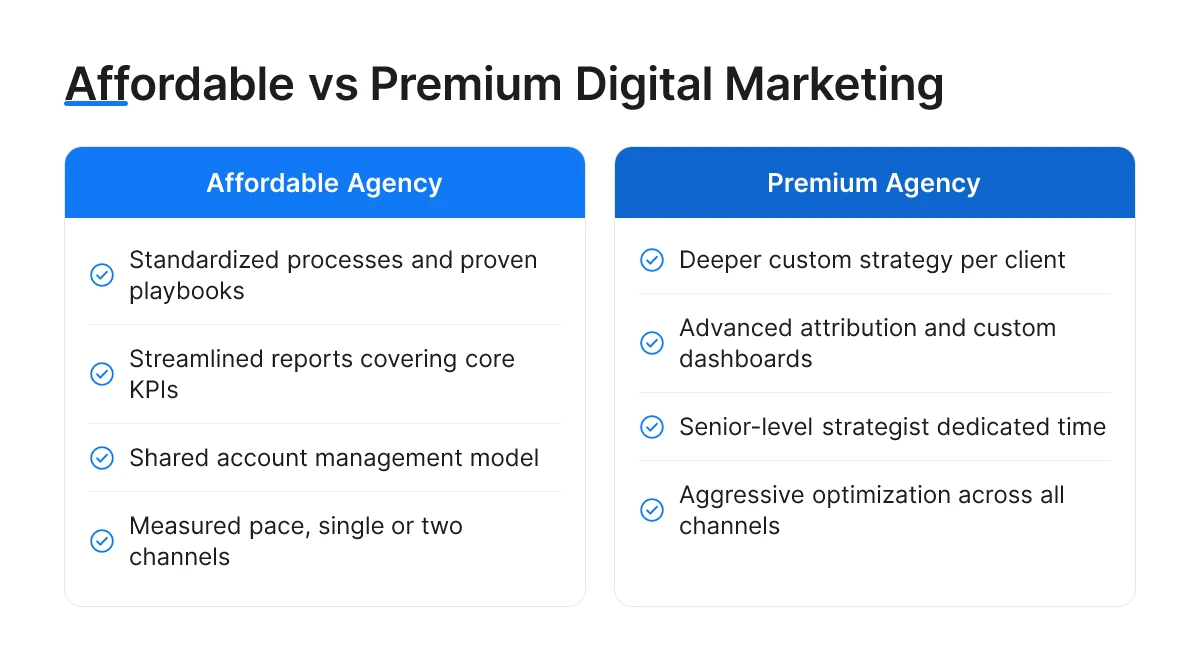
An affordable digital marketing agency delivers the same core channels as a premium firm, but with standardized processes instead of deep custom strategy and senior-level attention.
The difference isn’t quality of channel, both tiers run SEO, paid ads, and social campaigns. The difference is how much human strategy time and customization sits behind each campaign decision.
What are you actually sacrificing when you choose an affordable agency over a premium competitor?
Mostly speed of iteration and depth of personalization, not the fundamentals. Premium agencies typically assign senior strategists who rebuild campaign logic frequently, testing new audiences, creative angles, and bidding structures on a tighter cycle. Affordable agencies rely on proven, repeatable systems and shared account management across multiple clients, which keeps costs down but means optimization happens on a longer cadence.
Reporting depth follows the same pattern. Premium tiers often build custom dashboards with advanced attribution modeling that trace a lead back through every touchpoint it crossed. Affordable tiers cover the same core KPIs, traffic, leads, cost per acquisition, through standardized reports that are easier to produce and still answer the question owners actually ask: is this working?
When does paying more for a premium agency make sense versus choosing an affordable alternative?
Premium spend earns its keep in specific, higher-complexity situations:
- Multi-market or multi-state campaigns: These need the coordination layer premium agencies are built to manage across regions.
- Highly competitive industries: When competitors bid aggressively on the same keywords, constant creative testing often requires more strategist hours than a lean team can provide.
- Heavy custom creative needs: Businesses that depend on frequent custom video, design, or landing page experimentation tend to outgrow standardized packages fast.
For an established local or regional business with a steady service area, the affordable tier usually covers the same fundamental channels, it simply moves at a measured, sustainable pace rather than an aggressive one. Motiliti’s model reflects this: dedicated project managers and transparent ROI reporting without the premium-agency overhead that a growing local business doesn’t yet need.
What’s the Difference Between Truly Affordable Pricing and Hidden-Fee Traps?
Honest budget-friendly pricing lists every cost upfront; a hidden-fee trap uses a low headline number to mask setup fees, ad-spend surcharges, or locked-in contract terms.
The gap between the two rarely shows up in the sales call. It shows up three months later, when an invoice includes charges nobody mentioned at signing. An affordable digital marketing agency worth hiring will put those numbers in writing before you commit to anything.
What contract terms and minimum commitments should you watch for when evaluating affordable agencies?
Read the contract for three things: setup fees, ad-spend management fees, and charges for reports or strategy calls billed separately from the retainer. Some agencies quote a low monthly rate, then add a percentage fee on top of every dollar you spend on Google Ads or Facebook Ads.
Watch the commitment terms just as closely. Long lock-in periods, contracts that auto-renew without a clear notice window, and steep early-termination penalties all limit your ability to leave if results don’t materialize. A fair agreement lets you exit with reasonable notice, not a penalty clause buried in section 14.
How can you spot misleading ‘affordable’ pricing that hides additional costs?
Ask directly whether the quote includes ad spend, third-party tool licenses, and content production, or whether those are billed separately. Agencies sometimes present a management fee as the full cost while ad spend, stock photography, or copywriting get added later as “pass-through” charges.
Before signing anything, request an itemized scope of work. Budget-friendly packages typically cover fewer channels and less reporting frequency; mid-range and premium tiers add more channels, deeper analysis, and more frequent strategy calls. Knowing where a quote sits on that scale before you sign prevents surprises after.
Providers such as Affordable Digital Marketing of Florida publish service scopes that give a useful reference point for what a straightforward, itemized package tends to include before add-ons come into play.
How Do You Know an Affordable Agency Will Actually Deliver Measurable Results?
Ask to see a sample reporting dashboard, the exact KPIs tracked, and how often someone walks you through the numbers before you sign anything.
An affordable digital marketing agency that’s worth hiring will show you what it measures without hesitation. If a sales rep gets vague when you ask “what does my report look like in month three,” treat that as a warning sign, not a minor gap.
What ROI metrics and case studies should an affordable agency be able to show you?
Ask for the specific KPIs they track, leads generated, cost per acquisition, conversion rate from visitor to inquiry, and a sample of how those numbers get reported month over month. A real agency can pull up a redacted client dashboard or a past report on the spot. If they can only describe results in general terms (“we drove great engagement”), they likely aren’t tracking the metrics that matter to your revenue.
Ask how often they review performance with you. Monthly check-ins are standard; quarterly is acceptable for smaller retainers, but silence between invoices is not.
How should an affordable agency’s results compare to what premium agencies deliver?
The measurement logic should be identical, leads, calls, sales, even if the tools and reporting cadence are simpler. A budget-friendly retainer might mean a straightforward spreadsheet update instead of a live analytics portal, and monthly summaries instead of weekly deep dives. That’s a fair tradeoff. What’s not fair is a report full of impressions, followers, or “engagement” with no line connecting those numbers to new clients.
Motiliti assigns a dedicated project manager to every client specifically to close that gap, someone who explains what changed month over month and why, tying activity back to business outcomes rather than handing over a dashboard and disappearing.
What Services Should Be Included in an Affordable Digital Marketing Package?
A realistic package covers SEO fundamentals, basic paid ad management, social media posting, and simple conversion fixes to an existing site, not every channel at once.
These four areas form the core of most budget-friendly engagements because they address the two things a growing business needs most: visibility and a website that converts the traffic it already gets.
- SEO fundamentals: Keyword research, on-page fixes, and Google Business Profile optimization.
- Paid ad management: Typically focused on a single platform, often Google Ads or Facebook Ads, managed for measurable ROI rather than run across five networks at once.
- Social media work: Consistent posting and community management, not full-scale content production.
- Conversion improvements: Narrow but targeted fixes, such as repairing a contact form, clarifying a call to action, or speeding up a slow-loading page.
Does affordable digital marketing work differently for e-commerce versus B2B versus local service businesses?
Yes, the right service mix shifts significantly depending on how a business actually generates revenue.
- E-commerce: Paid advertising and conversion rate optimization tend to matter more than anything else, since every visitor represents a potential transaction and small checkout fixes compound quickly.
- B2B and professional services: SEO and content-driven lead generation carry more weight, because buying decisions take longer and prospects research extensively before contacting a sales team.
- Local service businesses (HVAC, legal, accounting, construction): Local SEO, online reviews, and an active social presence do the heaviest lifting, since most customers search “near me” or ask for a referral before calling.
Should you expect SEO, PPC, social media, and email to all be included in an affordable package, or do costs vary by service?
Costs and time requirements vary by service, so an affordable digital marketing agency will usually phase channels in rather than running all four simultaneously.
SEO, PPC, social, and email each demand distinct skills and weekly attention, treating them as a single bundled activity is how budgets get spread too thin to move any single metric. A business with limited monthly spend is almost always better served by doing one or two channels well, then expanding once those channels show measurable traction, rather than running a shallow version of everything.
It can also help to see how other regional providers describe their scope. The Affordable Digital Marketing of Florida Facebook page shows the kind of ongoing client communication and campaign updates a small business might expect from a lean, locally-focused agency.

Frequently Asked Questions
Can an affordable digital marketing agency still provide a dedicated account manager?
Yes, and it’s one of the clearest signs a lower-cost agency runs a lean, well-organized operation rather than a stripped-down one. Motiliti, for example, assigns a named project manager to every client regardless of budget tier. Ask directly during the sales process whether you’ll get one point of contact or a rotating support queue.
How often should an affordable agency report on campaign performance?
Monthly reporting is the standard, with some agencies offering real-time dashboards between formal reviews. Reports should connect specific activities—ad spend, keyword rankings, content published—to business outcomes like leads and revenue, not just vanity metrics like impressions or clicks.
Is it normal for an affordable agency require a minimum contract term?
Yes, three- to six-month minimums are common because SEO and paid campaigns need time to generate reliable data. Be cautious of contracts longer than 12 months with no performance checkpoints or exit clauses. A reasonable agency ties renewal to demonstrated results, not just calendar time.
Should website design and development be part of an affordable digital marketing package?
It should be included or at least available if your current site can’t support lead capture and conversion tracking. A site built five or more years ago often lacks mobile optimization and analytics integration, which undermines every other marketing dollar spent. Motiliti bundles website design with SEO and advertising so the site actively supports campaign goals rather than working against them.
Can a small business switch from an affordable agency to a premium one later without starting over?
Usually, yes, especially if the affordable agency kept clean records. A well-run budget-friendly engagement should leave behind organized reporting history, documented strategy notes, and access to analytics accounts, all of which a premium agency can build on rather than recreate. Ask any prospective agency upfront whether you’ll retain full ownership of accounts and data if you ever switch providers.
Conclusion
Affordable doesn’t have to mean generic. The agencies worth hiring pair budget-conscious pricing with the fundamentals that actually move revenue: a real point of contact, monthly reporting tied to business outcomes, and a website built to convert traffic instead of just display it.
Before signing anything, ask a prospective agency for a sample report from an existing client in your industry. If they can’t produce one that ties spend to leads within a week of asking, treat that as your answer.